Read Boil Water, Do Not Drink and Do Not Use as Different Instructions
A water notice should be read for its exact instruction, affected area and current status. Boil water is not a universal response to every contamination problem. Before changing household routines, open the official local notice and identify which kind of advisory applies rather than relying on a shortened message from somebody else.
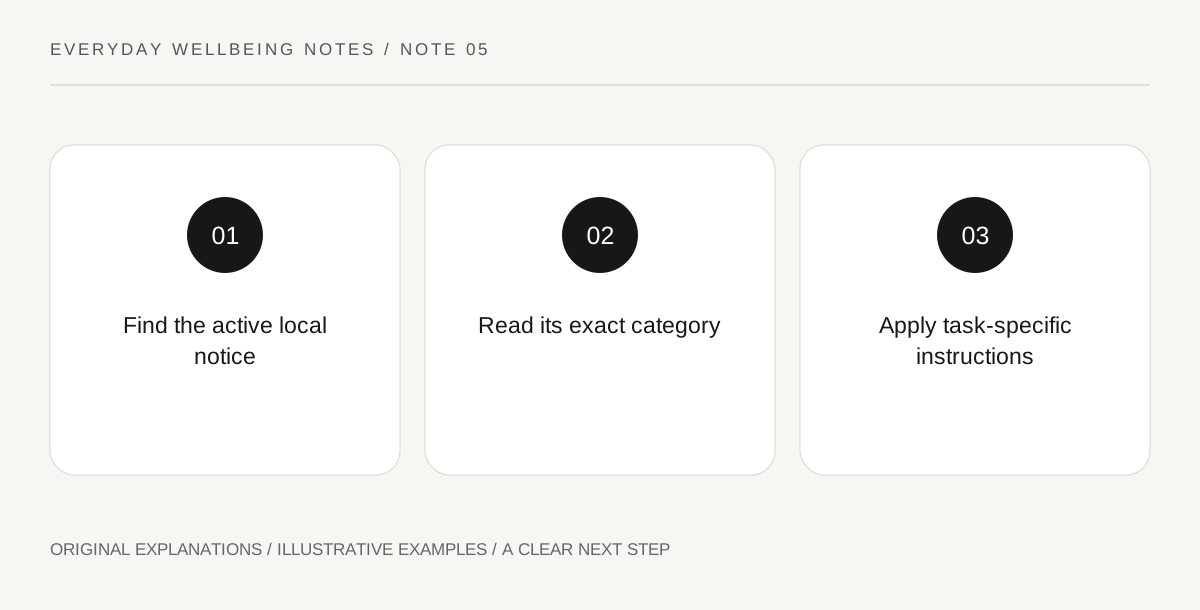
Original explanatory diagram. Read the full method and limitations below.
Find the active notice for the actual address
Read the issuing water supplier or local authority’s original update and check the affected area, start time and any later changes. A neighbouring district may have different instructions. Save a link or appropriate contact, but do not treat a saved screenshot as proof the notice is still active or has ended. An official lifting notice, not an informal observation that the water looks normal, establishes the updated instruction.
Keep the advisory categories distinct
CDC distinguishes boil-water, do-not-drink and do-not-use advisories. Some hazards are not solved by boiling. Read the local explanation and follow its specified alternatives rather than translating every warning into boil longer. Do not improvise a household filter or chemical treatment as a substitute. The appropriate action depends on the actual notice and contaminant, which this general article does not identify for your water supply.
Map instructions to ordinary water uses
List drinking, cooking, ice, brushing teeth, washing food, bathing and pet care, then find the notice’s guidance for each relevant use. If an important use is not addressed, ask the issuing authority. Avoid assuming that water allowed for one task is allowed for every task. Keep any personal medical or care requirements with the appropriate professional guidance rather than adapting them from a generic household checklist.
Plan the transition after an official update
When the authority changes or lifts the advisory, read any follow-up instructions for appliances, stored water, ice or plumbing before resuming normal use. Do not invent a flushing duration or assume a familiar filter removes every hazard. Keep the instruction date with your task list so household members know which version they are following. This helps prevent one person continuing an obsolete step while another starts a different routine.
Illustrative worked example
Illustrative example: A household receives a forwarded message saying water problem, boil it. The original local notice instead says do not drink and gives specific alternative-water instructions. The household follows that notice, checks the listed uses and asks the supplier about an unaddressed appliance. The fictional example shows why category wording matters; it does not describe a real contamination event or supply a universal water-treatment method.
Questions that come up
Does clear water mean an advisory has ended?
No. Appearance does not replace an official update or establish the absence of the relevant hazard. Follow the issuing authority’s current status and any instructions for resuming ordinary use.
Can I boil water during every do-not-drink notice?
Do not assume that boiling makes it suitable. CDC distinguishes advisory types because the hazards and required actions differ. Follow the actual notice and ask the authority about uncertainty instead of improvising treatment.
References and scope
These sources support the factual background. Examples and exercises are original illustrative teaching material. References do not imply endorsement.
- CDC: drinking-water advisories — Boil-water, do-not-drink and do-not-use notices are different; follow the current local notice.