A Home Radon Result Needs Its Testing Conditions Attached
A radon number becomes more useful when the testing method, location and dates remain with it. Before opening a kit or comparing an old result, read the complete instructions and appropriate local guidance. Testing is a defined measurement process, not a household experiment in changing windows until the number looks preferable.
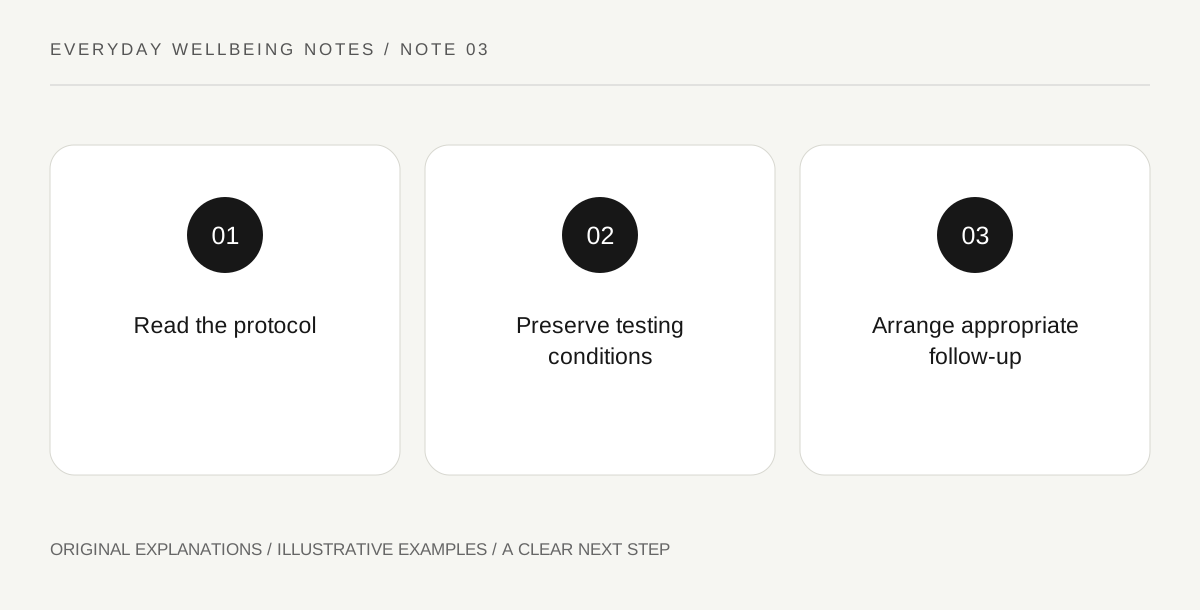
Original explanatory diagram. Read the full method and limitations below.
Identify the test’s purpose and method
Find whether the device or service is intended for a short-term or longer-term measurement and what question you are trying to answer. EPA guidance distinguishes testing correctly from simply owning an old result, and longer observation can describe a different period from a short test. Do not treat results with different durations as interchangeable snapshots or assume a neighbour’s result establishes the level in your own home.
Read placement and condition requirements first
Follow the specific kit or professional service instructions, including appropriate placement, timing and any required building conditions. Ask your local radon program or a qualified provider if the requirements are unclear. Do not move a device to a more convenient shelf during measurement or change conditions to influence the result. This article deliberately does not replace the protocol with one generic room-placement instruction.
Keep a concise measurement record
Record the device or service identity, start and finish dates, location and any departure from the instructions. Preserve the laboratory or provider report rather than copying only the final number into a general household notebook. Include its unit. If something disrupted the process, tell the provider; do not silently interpret the reading as though the test had followed its planned conditions throughout.
Plan follow-up through the appropriate program
Read the report’s follow-up guidance and consult the relevant local radon authority or qualified professional about the next step. Testing and mitigation are separate tasks. Avoid trying to lower a reading through improvised ventilation and declaring the problem resolved. If the house or its use changes, ask whether further testing is appropriate instead of assuming a result remains representative indefinitely.
Illustrative worked example
Illustrative example: A homeowner finds an old report containing a number but no remembered test location. Rather than comparing it directly with a neighbour’s recent kit, the homeowner obtains the original documentation and asks the local program what information is needed for a useful new test. During the new process, a disruption is recorded for the provider. The fictional example does not interpret a radon level or prescribe a mitigation method.
Questions that come up
Can a neighbour’s low result substitute for my home’s test?
No. Use appropriate testing for the actual home and question. A nearby result does not establish your own indoor measurement, and an assumed similarity is not a reason to skip relevant local guidance.
Should I move the kit if the number seems high?
Do not change the procedure to obtain a preferred reading. Follow the instructions, preserve the record and ask the provider or local program about appropriate interpretation and next steps.
References and scope
These sources support the factual background. Examples and exercises are original illustrative teaching material. References do not imply endorsement.
- EPA: home radon testing — Correct testing and appropriate follow-up matter; a short test is not the same as a year-round average.