Cleaning, Sanitizing and Disinfecting Are Different Jobs on a Surface Label
A clean-looking surface and a disinfectant claim describe different things. Before choosing a household product, identify the task and read what the product is intended to do on that surface. Using more chemical strength or more products is not a substitute for matching the actual instruction to the job.
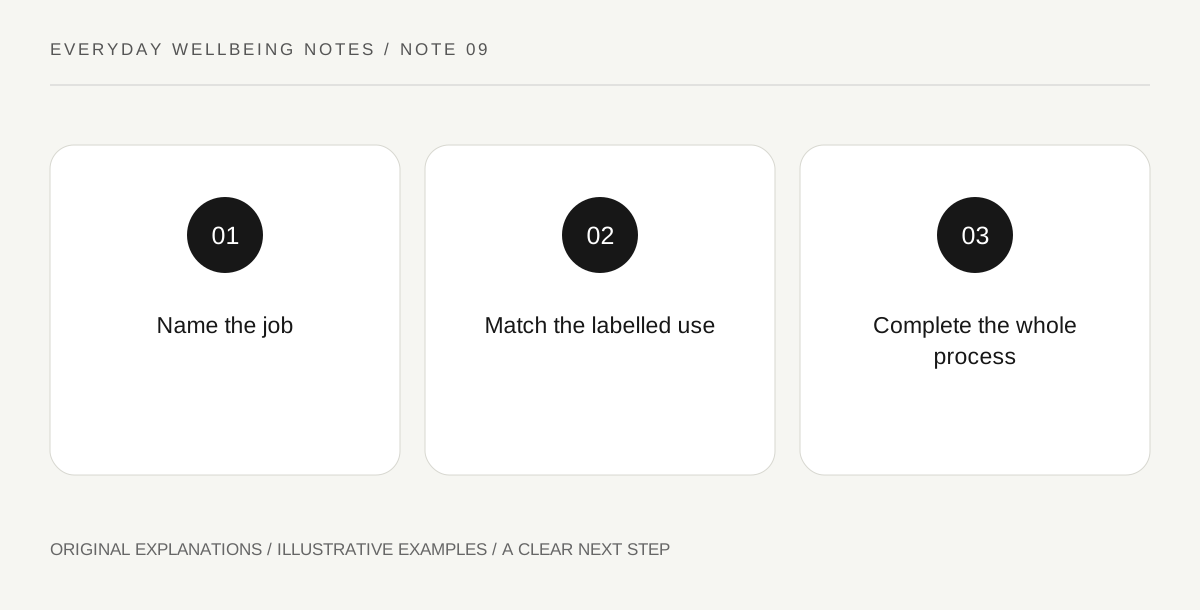
Original explanatory diagram. Read the full method and limitations below.
Name the task before choosing the bottle
EPA distinguishes cleaning, sanitizing and disinfecting as different surface-related purposes. Read the product’s stated use rather than treating these words as decorative synonyms. An ordinary dirt-removal task does not automatically require the same process as a situation with specific disinfection guidance. Follow relevant public-health instructions for illness or contamination, and ask for appropriate advice if the situation goes beyond ordinary household cleaning.
Check the surface and use-site wording
A product intended for a particular hard surface should not be assumed suitable for skin, food or every household material. Read the actual label for the intended site, application method and any exclusions. If the surface maker gives a care instruction, compare it with the product’s permitted use. Resolve a conflict before applying anything rather than treating the strongest claim on the front as permission for every surface.
Read preparation and finishing as part of the task
Find any stated pre-cleaning, ventilation, protective-equipment and rinsing requirements. A quick spray and wipe may omit an instruction that matters to the intended use. Do not replace the label with a recipe from a similar-looking bottle, and do not mix cleaners or disinfectants. CDC explicitly warns against mixing them. Keep products in their original labelled containers and store them securely according to their instructions.
Choose a routine that can be followed completely
Identify the supplies and time required before starting. Keep people and pets away as instructed and leave the area ready for its next permitted use. If the label cannot be read or the product identity is unknown, do not guess at dilution or purpose. Obtain appropriate information or choose a clearly documented suitable product instead. Completion means following the relevant process, not merely producing a strong smell or a visibly shiny finish.
Illustrative worked example
Illustrative example: An adult plans to remove ordinary marks from a compatible tabletop. One bottle is an identified cleaner; another has a different disinfectant use statement and additional instructions. The adult chooses the product appropriate to the task and surface, follows its complete directions and stores it securely afterward. The invented comparison does not rank products or claim that an informal wipe has sterilized the table.
Questions that come up
Does a stronger smell prove better disinfection?
No. Smell is not a validation method. Use a suitable identified product according to its label and relevant official guidance instead of judging effectiveness by fragrance or irritation.
Can a household surface product be used on food or skin?
Do not assume so. Those are different intended uses. Read the actual product directions and exclusions, and never extend a surface claim to another application without appropriate explicit instructions.
References and scope
These sources support the factual background. Examples and exercises are original illustrative teaching material. References do not imply endorsement.
- EPA: clean, sanitize and disinfect — Cleaning, sanitizing and disinfecting are distinct surface-product purposes.
- CDC: disinfecting with bleach — Never mix cleaners or disinfectants; article provides no dilution recipe.