A Weekly Container Check Can Be More Specific Than Buying Another Mosquito Gadget
A garden or balcony can collect water in small objects that are easy to overlook during ordinary tidying. Build a simple route through the containers you control and identify what can be emptied, scrubbed, covered or removed. This is a household maintenance task, not a promise to eliminate every mosquito or substitute for local public-health advice.
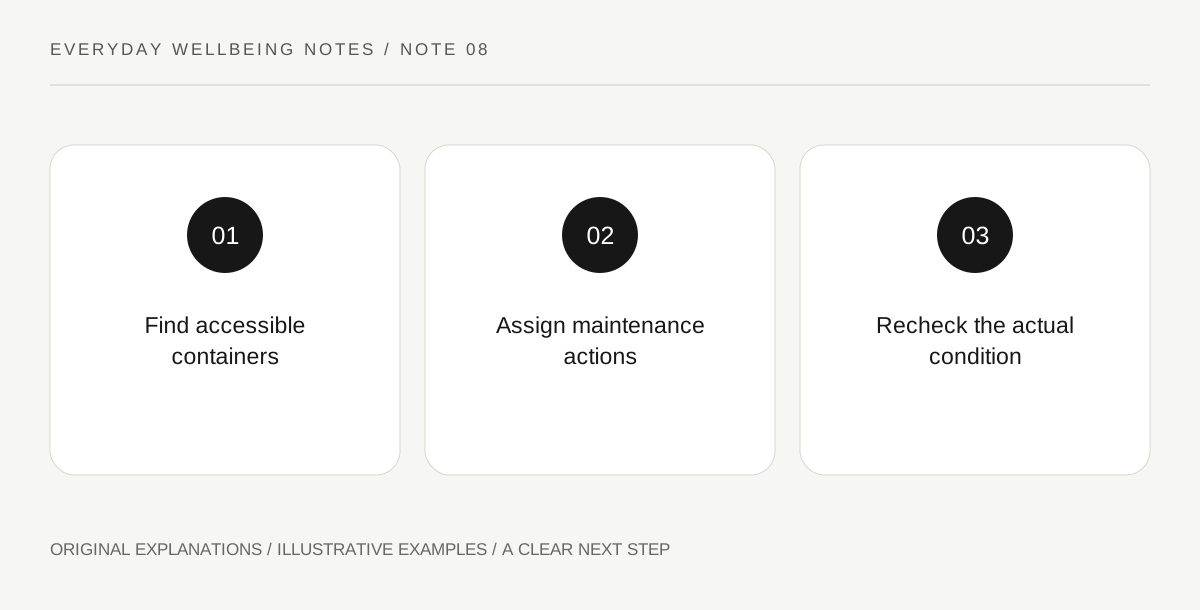
Original explanatory diagram. Read the full method and limitations below.
Look for water-holding objects rather than a perfect yard
CDC’s home mosquito-control guidance includes regular attention to items that hold water. Walk only through accessible areas you are responsible for and identify objects such as saucers, buckets or unused containers. Do not climb, reach into hidden cavities or disturb unknown water hazards to complete a checklist. A manageable route should address ordinary objects safely, while inaccessible drainage or structural issues need the appropriate property service.
Assign an action to each container
For each relevant object, decide whether to empty and scrub it, turn it over, cover it appropriately or remove it according to official guidance and its intended use. An object that must hold water needs an appropriate maintenance plan rather than a blanket instruction to discard it. Keep animal-care and garden requirements in mind and ask a suitable professional about specialized systems. Do not add improvised chemicals to solve an unclear maintenance question.
Make the routine repeatable after ordinary use
CDC describes a weekly container check. Choose an existing household task that can remind you to revisit the route, and notice when rain or an activity creates new water-holding items. The reminder is for checking the actual condition, not mechanically recording completion from indoors. If responsibility is shared, assign areas clearly so each person does not assume the other handles the same hidden corner.
Keep product choices separate from source control
A repellent, trap or other product has its own instructions and limits; it does not make the container route unnecessary. Avoid interpreting a successful tidy-up as proof that bite prevention or local advisories no longer matter. If the problem persists or concerns shared spaces, contact the property manager or relevant mosquito-control service. Do not escalate through larger quantities of an unfamiliar pesticide.
Illustrative worked example
Illustrative example: An adult household lists five accessible balcony objects. Two unused pots are turned over, a saucer is cleaned and managed, and a shared drainage issue is referred to the building manager. The household adds the route to a weekly maintenance reminder and revisits it after using the balcony. This invented routine does not claim a measured reduction in mosquitoes or guarantee that the area is free of disease risk.
Questions that come up
Does this routine guarantee no bites?
No. It addresses one part of home mosquito control. Continue to follow relevant local advice and properly labelled protective measures rather than treating container maintenance as a complete shield.
Should I pour a household cleaner into standing water?
Do not improvise chemical treatment. Follow official guidance for the actual situation and seek appropriate assistance when ordinary safe container maintenance does not address the problem.
References and scope
These sources support the factual background. Examples and exercises are original illustrative teaching material. References do not imply endorsement.
- CDC: mosquito control at home — Routine removal or management of standing-water containers, without DIY pesticide recipes.