A Disinfectant’s Wet Contact Time Is Part of Its Use Instruction
A disinfectant label may specify how long a treated surface must remain wet for the stated use. That interval is not the same as how long you hold a wipe or how quickly a surface looks dry. Read the relevant direction before starting so you can follow the complete process rather than inventing a shortcut.
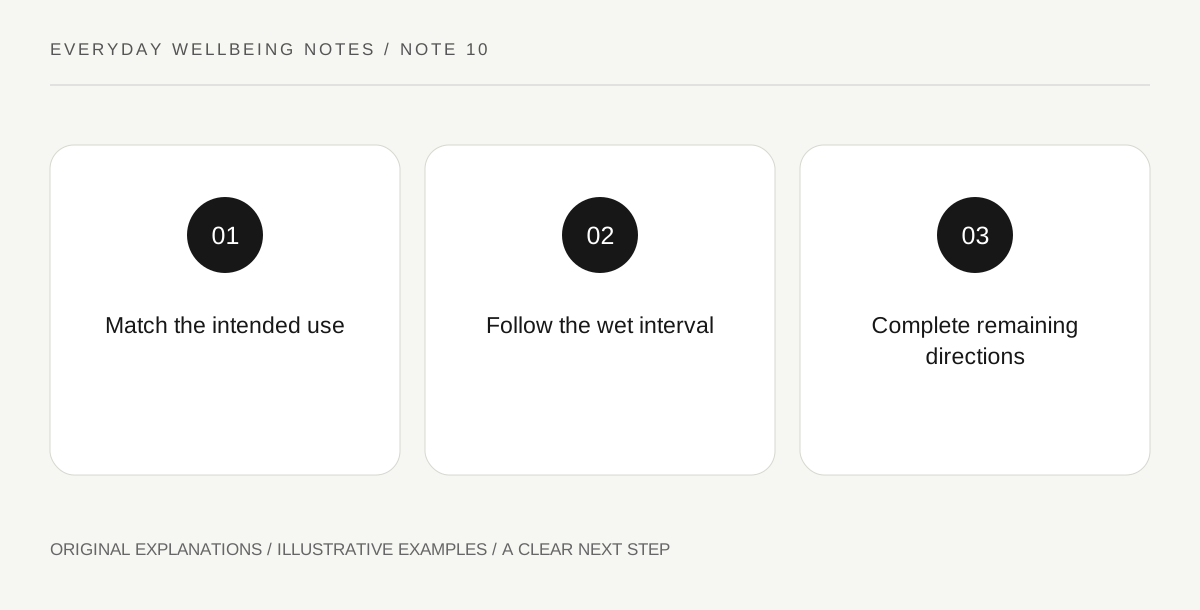
Original explanatory diagram. Read the full method and limitations below.
Find the instruction for the intended use
EPA explains that users need to check the approved use site and relevant directions for a registered disinfectant. A label can contain more than one application or claim. Identify the one that actually matches your surface and purpose, then read its preparation and contact-time requirements together. Do not borrow a shorter time from another product, a different organism claim or an advertisement that omits the conditions.
Distinguish application from the wet interval
The time spent moving a wipe across a table is not necessarily the interval during which the required area remains wet. EPA describes contact time in terms of the surface remaining visibly wet for the specified period. Follow the label’s instructions for achieving that condition; do not improvise repeated applications, dilution changes or mixtures. If the process is unclear or impractical, seek appropriate product guidance before beginning.
Plan the space while the process is underway
Read any directions about ventilation, protective equipment, access restrictions, rinsing and readiness for the surface’s next use. Arrange the task so children, pets or other users do not interrupt the stated process. A timer can help track a clearly understood interval, but it cannot validate an unsuitable product or an incorrectly prepared surface. Keep the relevant label visible rather than remembering a number without its context.
Keep completion claims proportionate
After following the instruction, describe what you actually did: used the identified product according to its relevant directions. Do not claim that a home surface is sterile or that every possible hazard has been removed. Store the product as directed and dispose of used materials appropriately. If something went wrong, consult the maker or appropriate safety service instead of compensating with a stronger mixture or a second unrelated chemical.
Illustrative worked example
Illustrative example: A fictional label specifies a wet interval for an allowed hard-surface use. A household member initially wipes the surface dry immediately, then notices that this does not match the instruction. Before the next task, they read the complete process and plan enough uninterrupted time to follow it. The example intentionally supplies no universal number, because the correct interval belongs to the actual product and use.
Questions that come up
Can I use one remembered contact time for every disinfectant?
No. Read the actual label for the relevant product, use site and claim. A number detached from those conditions can be misleading even when it came from another legitimate product.
Does setting a timer prove the surface was disinfected?
No. A timer helps track one instruction only. Product suitability, preparation, application, wet conditions and other label requirements still matter, and a household process should not be described as sterilization without appropriate evidence.
References and scope
These sources support the factual background. Examples and exercises are original illustrative teaching material. References do not imply endorsement.
- EPA: disinfectant selection and contact time — Use-site instructions and the label-specified wet contact time matter to the claimed use.