Ask Who Assigned the Behaviour Before Reading a Health Association as a Cause
Two groups can have different health results without the headline establishing why. Before treating an association as an instruction, find out how people entered the groups and whether researchers assigned an intervention. This design question helps you read the claim accurately without either dismissing observational research or overstating what one report proves.
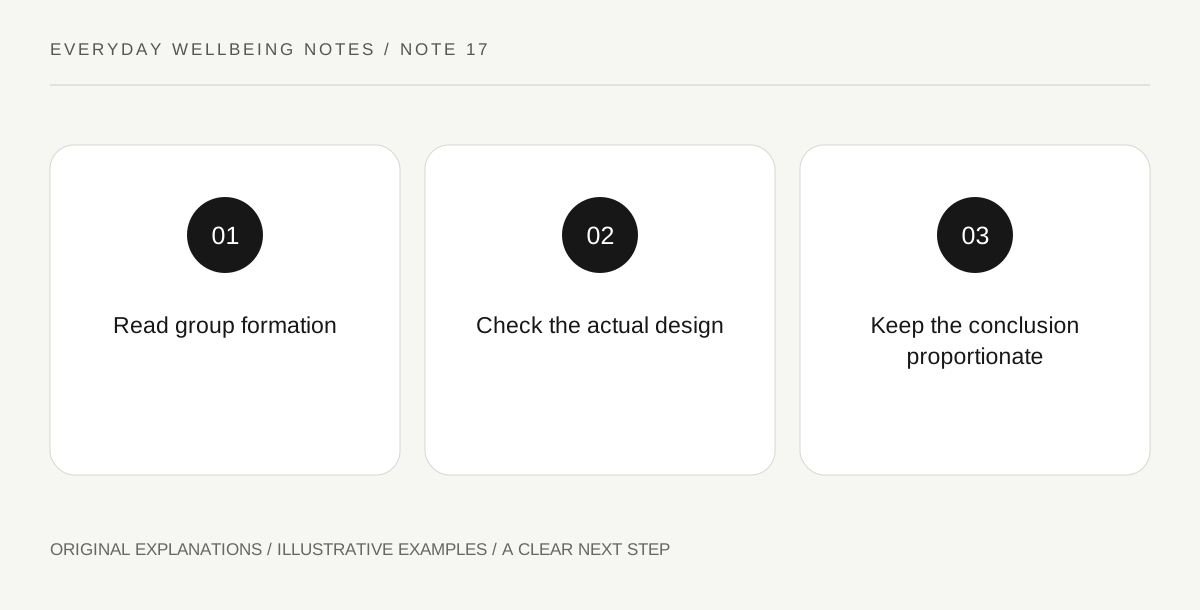
Original explanatory diagram. Read the full method and limitations below.
Find the group-formation description
NIH educational material distinguishes observational research from clinical trials. In an observational study, researchers may record existing behaviours or circumstances rather than assign a change. In a trial, an intervention is assigned under a protocol, although not every trial uses the same design. Read the method or a clear primary summary instead of guessing the design from words such as breakthrough, major or study in the headline.
Ask what else may differ between groups
People who choose a behaviour can differ in other relevant ways. Write down which factors the study measured or accounted for, without assuming that an adjustment automatically removes every possible difference. This is a question about interpretation, not an invitation to invent a flaw that invalidates the research. A careful article can report a useful association while preserving the uncertainty about its explanation.
Keep trial details visible too
If researchers assigned an intervention, ask about the comparison group, allocation method, follow-up and limitations actually described. Random assignment is different from merely enrolling volunteers, and the word trial alone does not establish randomization. Do not turn a design label into proof that every practical question is answered. Read whether the report supports its particular conclusion rather than ranking all studies from a single word.
Rewrite the claim at the level supported
For an observational finding, a cautious reading note can say that a behaviour was associated with a stated result in the studied group. Do not turn that sentence into everyone should begin the behaviour tomorrow. If a finding matters to an existing health decision, ask an appropriate professional about the broader evidence and personal relevance. One useful reading session can end with a precise description and a question rather than a new routine.
Illustrative worked example
Illustrative example: A fictional headline says people with a particular hobby reported a different health result. The underlying description says participants chose their own hobbies; no activity was assigned. The reader records an association and asks what other group differences were considered. The example supplies no real health effect and does not imply that any hobby causes, prevents or treats a condition.
Questions that come up
Is an observational study useless?
No. It can describe patterns, investigate questions and inform further research. Read it for the question and method it actually uses, while avoiding a causal instruction that the headline alone does not establish.
Does the word trial guarantee random assignment?
No. Check the actual design description. Randomization, comparison arrangements and follow-up need to be read explicitly, and no single design label replaces consideration of the report’s limitations and relevance.
References and scope
These sources support the factual background. Examples and exercises are original illustrative teaching material. References do not imply endorsement.
- NIH News in Health: when clinical research is in the news — Observational and intervention designs address different research questions; neither headline alone establishes personal advice.