FDA Registered Is Not the Same Claim as a Device Being Cleared or Approved
A medical-device advertisement may display a certificate-looking image or regulatory phrase that seems reassuring. Identify exactly what status is claimed and which device it concerns. In the United States, establishment registration and device approval or clearance are different matters, so a familiar government acronym should begin a check rather than end it.
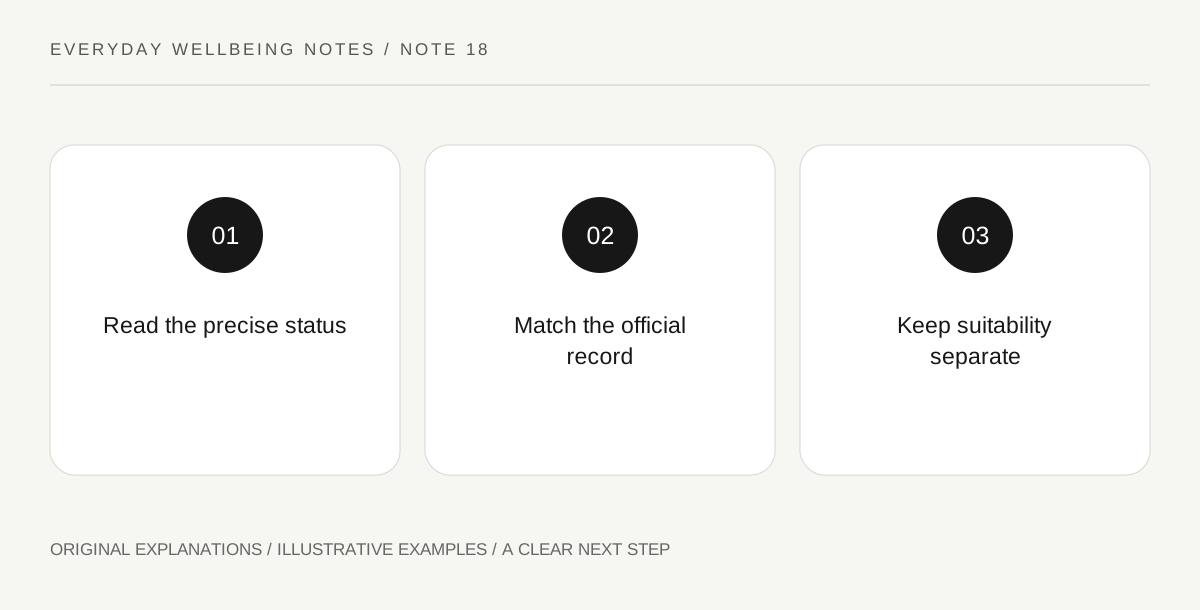
Original explanatory diagram. Read the full method and limitations below.
Read the noun attached to the claim
FDA explains that registering an establishment and listing its devices does not denote approval, clearance or authorization. Copy the exact phrase from the advertisement rather than shortening everything to FDA approved. A facility name and a product model are different identities. If the seller changes wording between the main image and detailed description, keep that discrepancy unresolved until a reliable explanation is available.
Do not authenticate by certificate appearance
FDA states that it does not issue device registration certificates to facilities. A document with a seal or formal layout is therefore not proof of the approval a reader may assume it represents. Use the agency’s published guidance and relevant official records instead of judging typography, an embedded logo or the seller’s confidence. Do not accuse an individual business of a specific violation solely from this general article.
Match any official record to the actual device
FDA describes ways to check approved or cleared product information through its device resources. Match the manufacturer and product identity and read the intended use and other relevant documentation. A genuine record for one product does not establish the status of a different model or support every new benefit claimed in an advertisement. If the record cannot be matched, ask for appropriate clarification rather than silently substituting a similar name.
Keep status separate from personal suitability
An identified regulatory status is not an instruction that a particular person should buy or use the device. Read the actual instructions and consult an appropriate healthcare professional for a relevant medical decision. Do not change prescribed care because an online device promises a simpler alternative. This guide is about understanding the evidence behind a marketing phrase, not reviewing a product or determining whether it is suitable for your condition.
Illustrative worked example
Illustrative example: A fictional advertisement shows a registration document next to a home medical device. A reader learns that registration is different from approval, then asks for the exact model and relevant official record. The reader does not treat a certificate-style image as evidence that all advertised benefits were reviewed. No real company is assessed, and no purchase or treatment recommendation follows from the fictional exercise.
Questions that come up
Does a registration entry mean the device is FDA approved?
No. FDA explicitly distinguishes registration and listing from approval, clearance and authorization. Read the specific status and check the relevant official product information instead of treating those terms as interchangeable.
If a device has a genuine record, is every advertised benefit established?
Do not assume that. Read the actual intended use and supporting documentation for the identified model. Personal suitability and any change to medical care require appropriate professional guidance beyond a marketing status check.
References and scope
These sources support the factual background. Examples and exercises are original illustrative teaching material. References do not imply endorsement.
- FDA: registered, approved and cleared devices — Registration does not mean approval or clearance; check specific device identity and intended use.