A Risk Reduction Needs the Starting Chance and Time Period
A headline saying risk was cut in half can sound very different once you see the starting chance. Read the absolute numbers and the time period before deciding what the percentage describes. This is a numeracy exercise for understanding a report, not a calculation of your personal risk or a reason to change treatment.
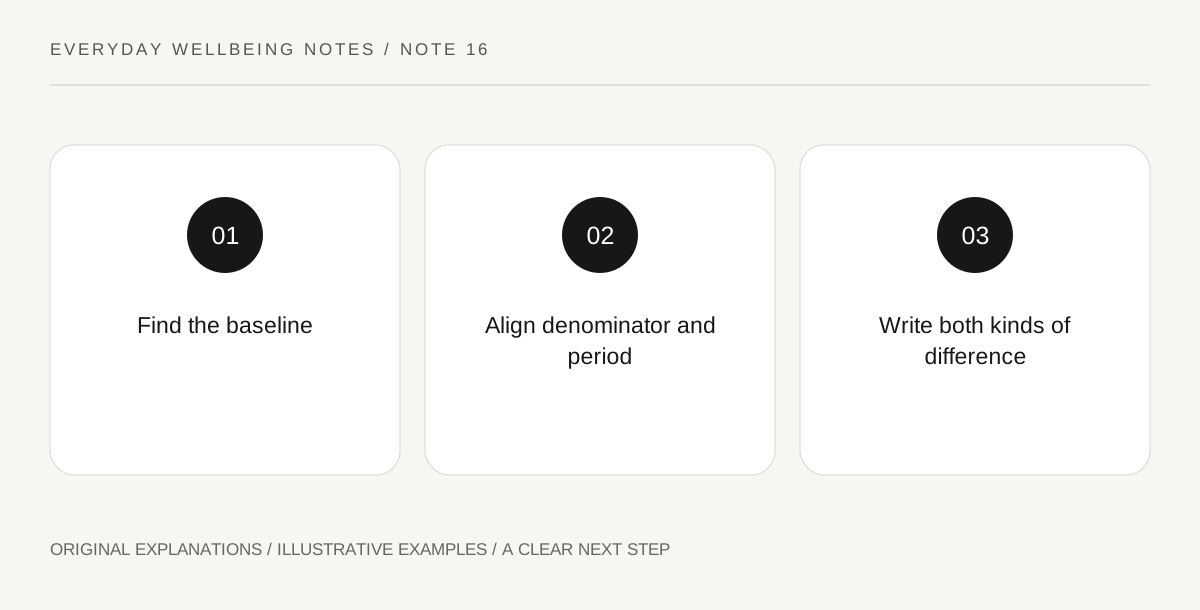
Original explanatory diagram. Read the full method and limitations below.
Identify the kind of number
NCI distinguishes absolute risk, a chance of an event over a defined period, from relative risk, which compares risks between groups. Keep those descriptions beside a report’s numbers. A percent change and a percentage-point difference are different quantities. If a headline omits the baseline, the relative statement alone does not tell you how many events occurred or the size of the absolute difference.
Put both groups over a common denominator
For a simple teaching comparison, express both reported chances using the same denominator and period when the source permits it. Do not invent missing denominators or combine results from different populations and durations. A chance over one year cannot be compared directly with a lifetime chance by ignoring the dates. If the paper reports another measure such as an odds ratio, do not silently relabel it as a risk ratio.
Calculate only what the example supports
Using fictional risks of 20 in 1,000 and 10 in 1,000 over the same invented period, the absolute difference is 10 in 1,000, or one percentage point. The second chance is half the first, so the relative reduction is 50 percent. Both descriptions can be mathematically correct. Neither says that half of every person’s existing health problem disappeared or that the observed difference necessarily has a particular cause.
Keep the result separate from a personal decision
Read the actual study population, uncertainty and limitations before applying a result to another situation. A group estimate does not determine one person’s outcome, and an arithmetic transformation cannot supply missing evidence about benefits or harms. Discuss a relevant health decision with an appropriate professional. Your useful reading note can state the two chances, denominator, period and unanswered questions without recommending a product or intervention.
Illustrative worked example
Illustrative example: An invented headline highlights a 50 percent relative reduction. The underlying fictional table shows 20 events per 1,000 versus 10 per 1,000 over the same period. A reader writes both the relative reduction and the one-percentage-point absolute difference in the margin. These figures are deliberately fabricated for arithmetic practice and do not describe a disease, product, study result or personal prognosis.
Questions that come up
Is a relative percentage automatically misleading?
No. It can correctly describe a comparison, but the baseline and time period are needed to understand its practical size. Keep both relative and absolute descriptions where the source supports them.
Can I use a study’s group risk as my own exact chance?
No. Individual circumstances and the study’s applicability matter. A reading exercise helps clarify the reported number; it does not calculate a personal prognosis or replace appropriate professional advice about a health decision.
References and scope
These sources support the factual background. Examples and exercises are original illustrative teaching material. References do not imply endorsement.
- NCI: absolute risk — Risk as a chance over a defined period; all article numbers are invented teaching examples.
- NCI: relative risk — Relative risk compares risks; it is not a percentage-point difference.