A Repellent Label Must Match Skin, Clothing or the Surrounding Space
Products marketed against insects can be intended for different application sites. A spray for clothing or the surrounding area is not automatically a skin product. Before preparing for an outdoor activity, read the exact label and separate what the product is meant to treat from the benefit described on its front panel.
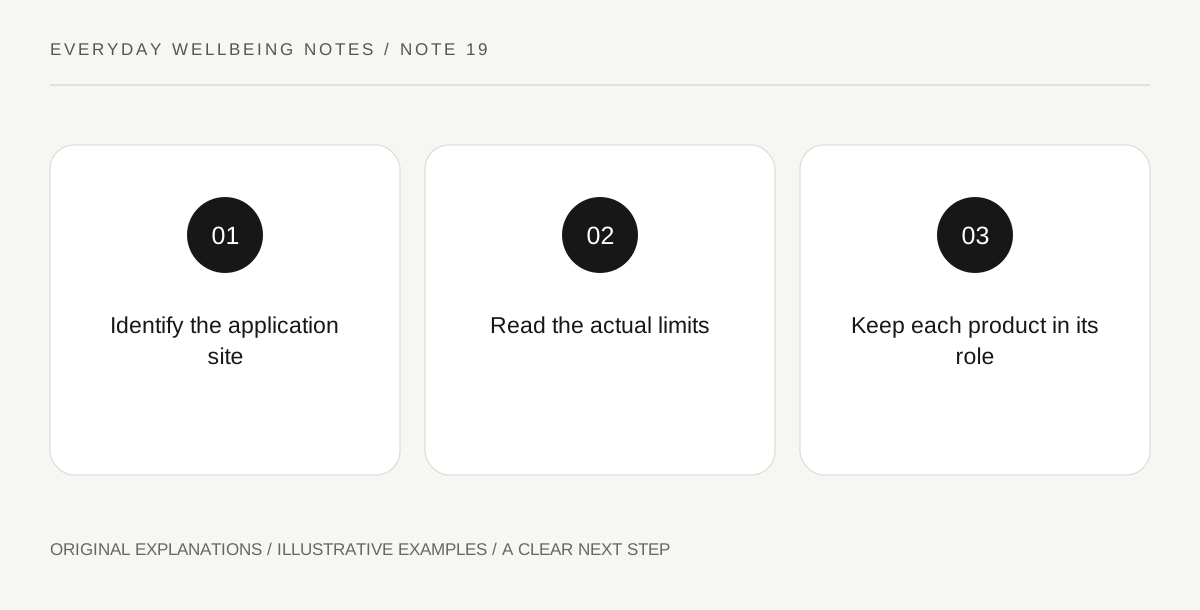
Original explanatory diagram. Read the full method and limitations below.
Identify the intended application site
EPA describes insect repellents as a broad product group and emphasizes following each product’s directions. Find whether the particular product is intended for human skin, clothing, equipment or a specified space. Do not treat the word repellent as permission for every application. A product used successfully by a friend may belong to a different category or variant, so identify the actual container rather than relying on a remembered recommendation.
Read limits before opening the product
Look for application directions, exclusions, relevant age restrictions, reapplication information and any precautions for the intended user. This general adult guide does not supply a universal dose or interval. Follow the label and appropriate professional advice for individual concerns. Do not apply more frequently or use a stronger improvised mixture because insects remain nearby, and do not assume a natural-sounding ingredient removes the need for precautions.
Keep products in their documented roles
If one item is intended for clothing, follow its directions for treatment and readiness before wear; do not apply it to skin unless that exact use is permitted. If another is a spatial product, check where it may be used and any access or ventilation requirements. Do not transfer the contents into an unlabelled travel bottle that loses the product identity and essential instructions. Store and transport the container according to its label.
Combine planning measures without inventing a guarantee
Use relevant local bite-prevention guidance and practical clothing or venue arrangements alongside properly selected products. Container maintenance at home and an individual repellent have different jobs. Neither establishes a guarantee against bites or disease. If the current product does not suit the activity or user, obtain appropriate advice rather than extending it beyond its permitted site. A well-read label can lead to choosing a different documented option or changing the plan.
Illustrative worked example
Illustrative example: An adult packing for a fictional local outing finds two sprays: one labelled for clothing treatment and another labelled for skin use. The adult reads each complete instruction, keeps them in their original containers and does not interchange their roles. An unclear product is left unused pending reliable clarification. The example does not name a recommended active ingredient, claim a protection duration or prescribe an application amount.
Questions that come up
Does repellent mean safe to apply anywhere?
No. Read the actual labelled site and directions. Skin, clothing and spatial uses are different possibilities, and a shared marketing word does not make the products interchangeable.
Can I add extra applications whenever insects are visible?
Follow the label’s directions and limits rather than improvising frequency or concentration. Seek appropriate advice about a suitable plan if the product or conditions do not meet your needs, and avoid assuming complete protection.
References and scope
These sources support the factual background. Examples and exercises are original illustrative teaching material. References do not imply endorsement.
- EPA: using insect repellents — Use the label for the particular product and application site; no improvised substitution or dosing.