Give Each Home Alarm an Identity and a Response Plan
A round device on the ceiling does not tell you which hazard it detects. A household alarm plan starts by identifying smoke, carbon monoxide and any combination units, then learning the actual instructions. Routine testing and emergency response are separate tasks, and the response should be understood before a warning occurs.
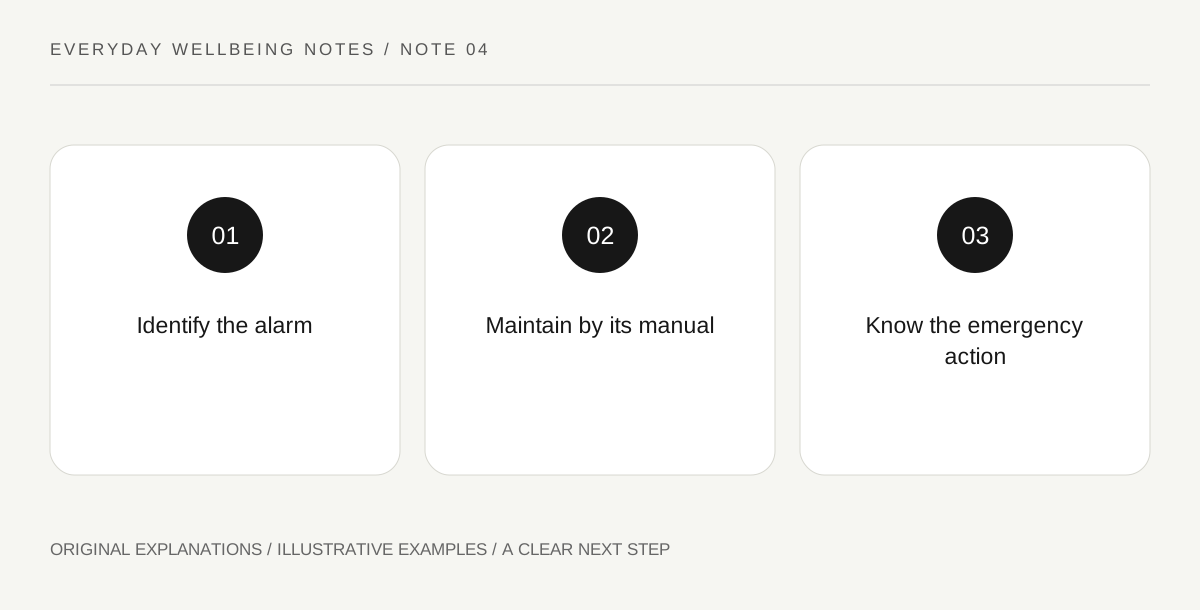
Original explanatory diagram. Read the full method and limitations below.
Identify the actual alarm type
Read the device label and matching manual without disabling it. CPSC notes that smoke and carbon monoxide alarms, including combination units, exist; do not assume a smoke-only device detects carbon monoxide. Record each unit’s model, location and purpose. If you cannot safely inspect it, ask the responsible building manager or appropriate professional rather than climbing unsafely or taking an unfamiliar unit apart.
Use the model’s maintenance instructions
Find the test procedure, power arrangement, replacement information and meaning of status signals in the exact manual. CPSC recommends regular testing, but individual devices and power systems still need their stated instructions. Do not infer that pressing a button checks every possible installation issue. Avoid removing power to stop an unexplained sound; get appropriate help identifying the signal and any required maintenance.
Know the carbon-monoxide emergency action
CPSC’s carbon-monoxide safety guidance directs occupants to move to fresh air and call emergency services when the alarm signals a CO emergency. Do not remain inside to search for a source, wait for symptoms or treat the alarm as a device experiment. Follow responders’ instructions and do not re-enter until they say it is safe. Use current local emergency guidance for your location.
Make the plan understandable to others
Explain the alarm types and response route to household members and relevant visitors through a calm discussion, not by creating a hazard. Keep manuals and building contacts accessible, and ask about appropriate accessible alerting arrangements if needed. Installation and coverage questions belong with applicable local requirements and qualified assistance. A notebook entry helps organize responsibilities but does not establish that a building’s alarm coverage is compliant or complete.
Illustrative worked example
Illustrative example: During a routine household review, Mina discovers that a hallway unit is smoke-only and a separate unit has a CO function. Mina saves both manuals, identifies their maintenance instructions and discusses emergency actions with the household. A building professional is asked about unresolved coverage questions. No alarm is deliberately triggered with smoke or gas, and this fictional review does not certify the home’s safety or installation.
Questions that come up
Can a smoke-only alarm stand in for a CO alarm?
Do not assume that. Read the device’s documented functions and get appropriate assistance with coverage and installation questions. Similar appearance does not mean the units detect the same hazard.
Should I investigate the source before leaving after a CO alarm?
No. Move to fresh air and call emergency services in accordance with official guidance. Leave investigation and safe re-entry decisions to responders rather than delaying action to troubleshoot the home yourself.
References and scope
These sources support the factual background. Examples and exercises are original illustrative teaching material. References do not imply endorsement.
- CPSC: carbon monoxide questions and answers — CO alarm planning, testing and response; follow actual alarm instructions and current local emergency guidance.