A Private-Well Water Sample Starts with the Laboratory’s Instructions
A bottle of water taken to a laboratory is not automatically a useful drinking-water sample. The sampling point, container, handling and requested tests must suit the question. If your home uses a private well, arrange appropriate certified testing and local guidance before collecting anything or purchasing a treatment device.
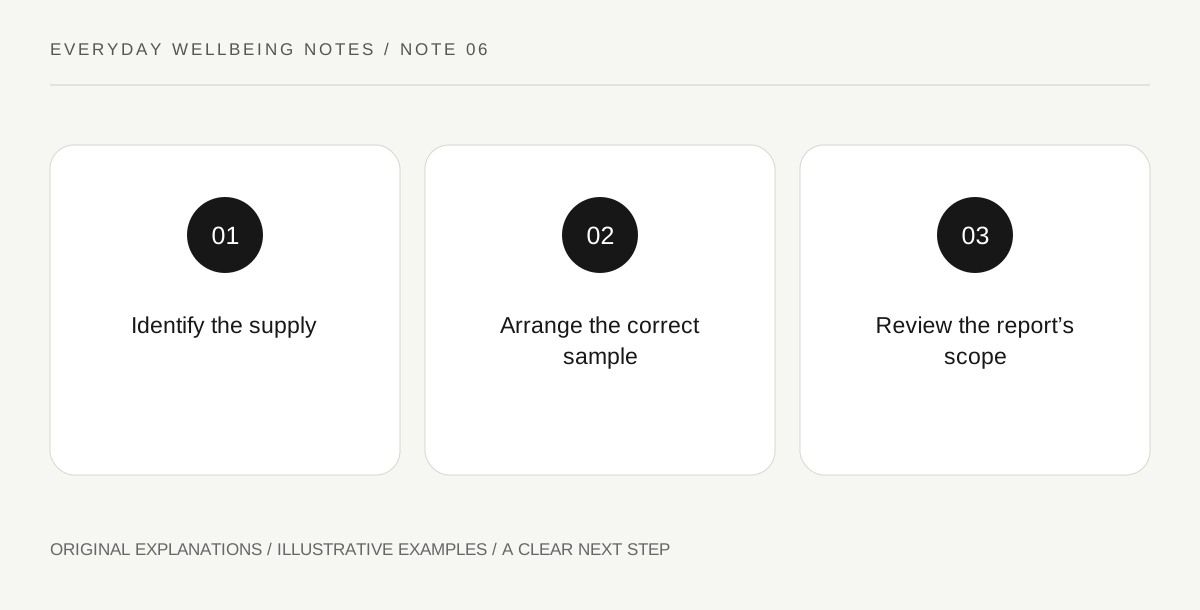
Original explanatory diagram. Read the full method and limitations below.
Confirm which supply you actually use
Identify whether the property receives community-system water, private-well water or another arrangement. CDC explains that private well owners have testing responsibilities different from public-system monitoring. Do not assume the utility report for a nearby town covers your private well. If you rent or share the property, clarify who holds the well records and who is responsible for arranging the necessary assessment rather than leaving the task unassigned.
Ask the appropriate local questions
CDC recommends a state-certified laboratory and local health-department guidance on relevant testing. Explain the property and reason for testing to the appropriate service. A routine check, a changed condition and a suspected contamination event may require different follow-up. Do not choose a panel solely because its package lists the largest number of substances. Ask whether it addresses the actual concern and whether any urgent precautions are needed before results arrive.
Follow the collection and delivery protocol
Obtain the laboratory’s instructions for containers, sampling location, timing, storage and delivery. Do not substitute a rinsed drinks bottle or assume one collection method works for every analysis. If a step was missed, tell the laboratory rather than hoping the result will still mean the same thing. Keep the sampling date, location and requested analyses with the record so the report can be interpreted in context.
Use the report for an appropriate next step
Ask the local health or environmental department for help understanding results and any needed action. A result covers the substances and sample conditions actually tested; it is not proof about every possible contaminant forever. Avoid choosing an improvised treatment from an isolated number. If action or repeat sampling is recommended, record who is responsible and the next contact rather than filing the report without resolving its instructions.
Illustrative worked example
Illustrative example: A household fills an ordinary jar before contacting a laboratory. The laboratory explains that the requested analysis needs its specified collection process, so the household does not submit the improvised sample as equivalent. They obtain the correct instructions, document the sampling point and arrange delivery. The invented example illustrates preparation and recordkeeping, not an assessment of any real well or a recommendation for a treatment system.
Questions that come up
Does clear, pleasant-tasting well water remove the need for testing?
No. Appearance and taste do not establish the absence of relevant contaminants. Follow appropriate official and local testing guidance for your actual well and circumstances.
Can one negative result certify the water indefinitely?
No. A report concerns the sample and analyses performed. Discuss appropriate ongoing testing and changed conditions with the relevant local service instead of extending one result to every future situation.
References and scope
These sources support the factual background. Examples and exercises are original illustrative teaching material. References do not imply endorsement.
- CDC: testing well water — Private well owners need appropriate testing through a state-certified laboratory and local guidance.