A Refrigerator Setting Is Not the Same as a Measured Temperature
A refrigerator control marked with numbers may indicate an adjustment level rather than the actual temperature inside. Read the appliance manual and use an appropriate appliance thermometer to understand the measurement. Keep the unit and reading context visible before assuming that a familiar dial position means the storage conditions are suitable.
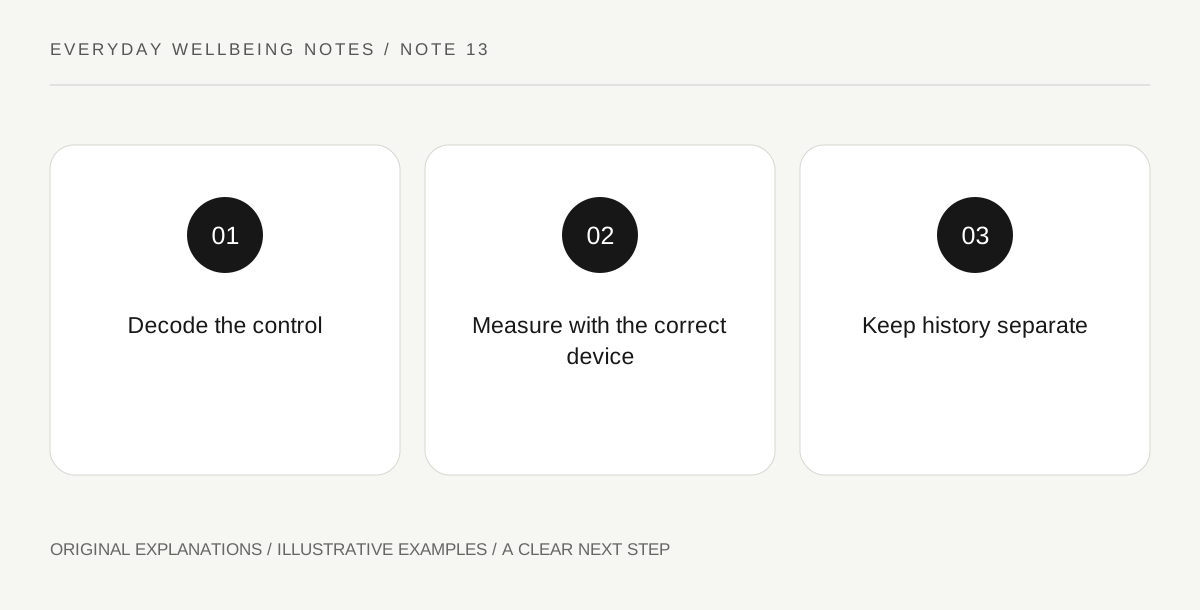
Original explanatory diagram. Read the full method and limitations below.
Identify what the control displays
Some controls show a target setting or numbered level, while a measurement reports a temperature at a particular place and time. Check your model’s manual to determine which you are seeing. Do not label a dial position as degrees if the appliance does not define it that way. A display that looks precise also needs its stated meaning; it may not represent every location inside the compartment.
Use the right kind of thermometer
FDA recommends an appliance thermometer to check refrigerator and freezer temperatures. Its U.S. guidance uses 40 degrees Fahrenheit or below for refrigeration and 0 degrees Fahrenheit or below for the freezer, approximately 4 and minus 18 degrees Celsius respectively. Keep the units attached and follow thermometer and appliance instructions for placement and reading. Do not substitute a body-temperature device or an unsupported sensor merely because it has a digital screen.
Read a pattern in its handling context
Record the observed value, unit and relevant ordinary event, such as recently stocking groceries, without repeatedly opening the door to chase a preferred number. Follow the appliance guidance about checking after adjustment. One reading should not be described as proof that every part of the refrigerator stayed at that temperature all day. If readings remain unsuitable or the appliance appears faulty, obtain appropriate service and food-safety guidance.
Keep food decisions separate from appearance
A working temperature check supports storage management but does not make previously mishandled food safe. Follow applicable food-specific storage instructions and official guidance when the temperature history is uncertain. Do not taste food to evaluate safety or infer it from a pleasant smell. This article addresses understanding the appliance reading, not a universal decision chart for every food or an instruction to retain items after a storage problem.
Illustrative worked example
Illustrative example: A reader sees the number four on a fictional refrigerator dial and writes four degrees in a household note. The manual identifies it as a control level, so the note is corrected. An appropriate appliance thermometer provides an actual reading with its unit and context. The reader follows the manual for any adjustment and seeks guidance for unresolved storage concerns. The example does not certify an appliance or determine whether particular food is safe.
Questions that come up
Can the dial position tell me the temperature by itself?
Only if the actual appliance documentation establishes what it means. Do not turn an unlabelled control number into degrees. Use the appropriate measurement method described by the appliance and thermometer instructions.
Does a good reading now prove food was always stored correctly?
No. It describes the measurement obtained, not every earlier condition. Follow official food-safety guidance for uncertainty about storage history rather than using the current display as a retroactive guarantee.
References and scope
These sources support the factual background. Examples and exercises are original illustrative teaching material. References do not imply endorsement.
- FDA: refrigerator thermometers — Appliance thermometers and recommended refrigerator/freezer temperatures; no claim that smell establishes safety.