A Food Recall Check Needs the Package Code, Not Only the Brand
A food-recall headline can name a familiar brand while the notice identifies a more specific product, package or production group. Open the official notice before deciding what is affected. Keep the physical package available, avoid tasting a suspect item and follow the notice’s actual handling instructions.
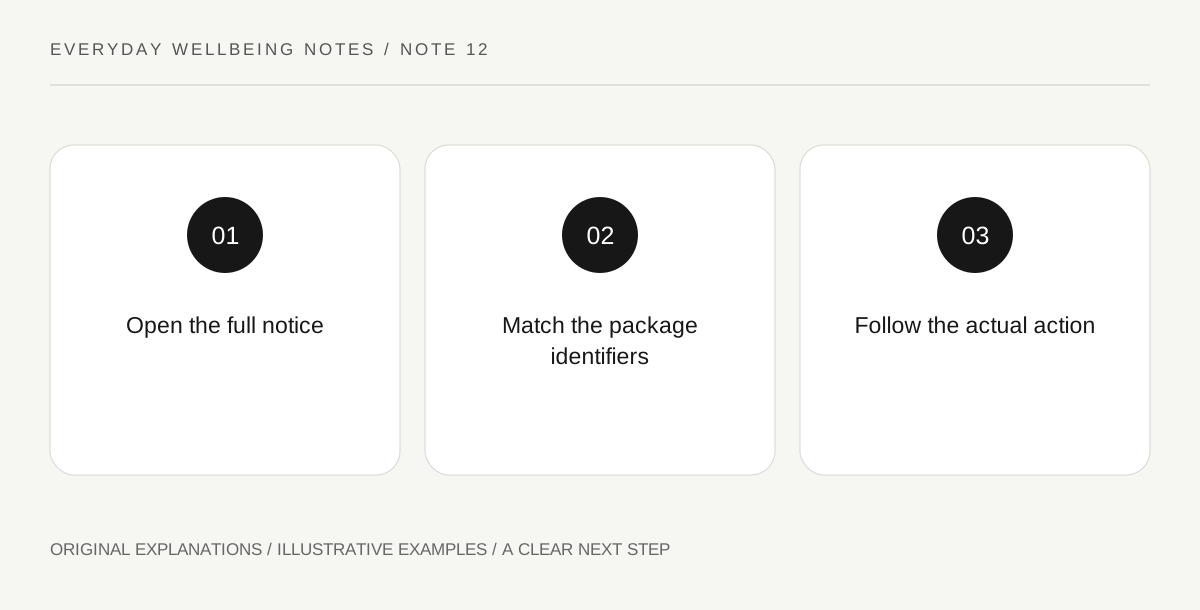
Original explanatory diagram. Read the full method and limitations below.
Read the product identification fields
FDA explains that recall notices can identify foods through names, sizes, package types, UPCs, lot codes, dates and distribution information. Compare the fields the actual notice provides, rather than assuming every product under the brand is included or excluded. Keep the notice date and any updates visible. A retailer’s short alert can be useful, but the full official information is needed when the abbreviated wording leaves an identification question.
Locate the code without altering the food
Look at the exterior package and any relevant label areas described in the notice. A lot code and a best-before date may occupy different places or serve different identification roles. Copy them carefully, including letters and separators. Do not open, taste or handle the food unnecessarily to determine whether it is affected. If the code is unreadable or the original package has been discarded, keep the match unresolved and seek official guidance.
Follow the stated consumer action
A recall may provide return, disposal, contact or cleaning instructions relevant to that event. Follow those instructions rather than improvising a cooking method to make the product acceptable. Do not donate or serve a recalled item to avoid waste. Keep it from accidental use while obtaining clarification. If illness or an exposure concern exists, seek appropriate healthcare guidance rather than trying to diagnose it from the recall headline.
Improve the information retained during ordinary storage
When decanting suitable products in future, retain enough original identification to connect the stored food to its package without mixing unrelated batches. A photograph can help only if the code and product identity remain legible and associated correctly. Do not treat recordkeeping as permission to extend storage or ignore the original instructions. The goal is a practical link between a notice and the actual food you own.
Illustrative worked example
Illustrative example: A household has two fictional packages bearing the same brand name. The notice lists a particular size and lot range. One package can be matched; the other has an unreadable code. The household follows the stated action for the matched item and contacts the official source about the uncertain one instead of declaring it unaffected. No real recall, product hazard or current affected batch is asserted.
Questions that come up
Does the same brand mean every package is recalled?
Not necessarily. Read the actual scope and updates. Some notices are specific while others are broader; use the published identifiers rather than extending or narrowing the recall by assumption.
Can cooking solve a recalled-food problem?
Do not assume so. Follow the official recall instructions for that product and hazard. An improvised preparation method is not a substitute for the stated return, disposal or other consumer action.
References and scope
These sources support the factual background. Examples and exercises are original illustrative teaching material. References do not imply endorsement.
- FDA: food recalls — Recall notices identify affected products through packaging, codes, dates and distribution details.