Contains and May Contain Serve Different Roles on a Packaged-Food Label
An ingredient list, a Contains statement and a precautionary May contain statement are different parts of a packaged-food label. Read them together rather than treating one missing phrase as an all-clear. For a known food allergy, follow the person’s clinical management plan and resolve uncertainty before eating or serving the product.
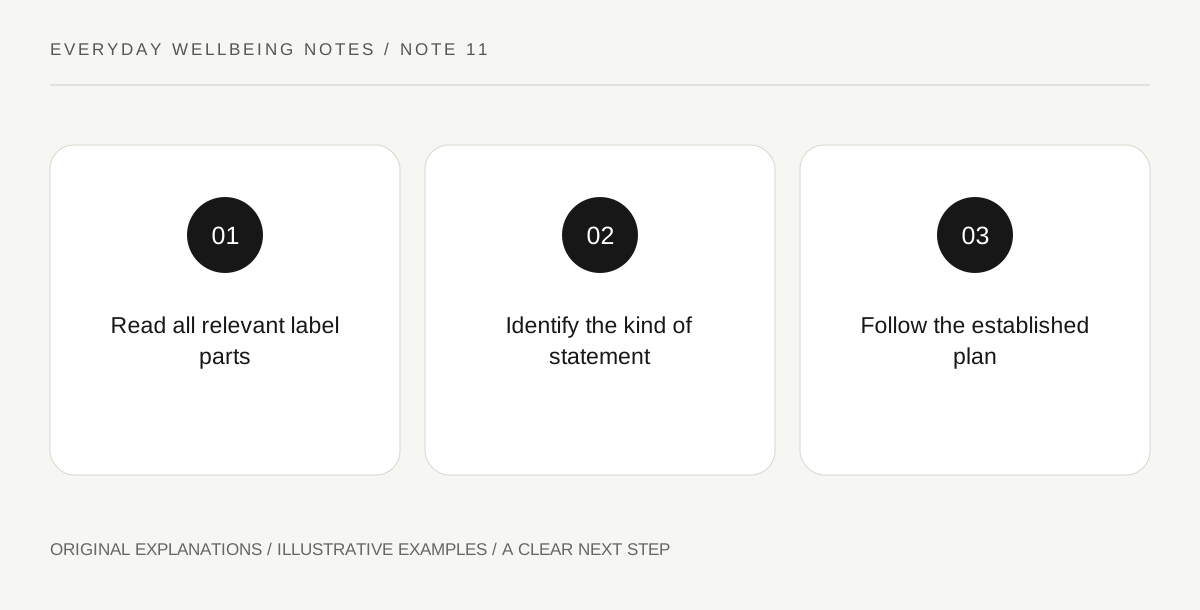
Original explanatory diagram. Read the full method and limitations below.
Read the actual package in front of you
Start with the complete ingredient list and allergen information on the specific product and variant. A familiar brand name or an old online photograph does not establish the current contents. FDA guidance explains major-allergen declarations for foods within its U.S. labeling scope. Keep that scope clear: not every food, setting or country uses identical requirements. An unpackaged meal requires an appropriate direct information process rather than assumptions from this article.
Keep ingredient declarations distinct from precautionary wording
FDA describes ways a major-allergen source can be declared through the ingredient information or an adjacent Contains statement. It separately describes voluntary precautionary wording about possible cross-contact. Those functions should not be merged. Do not read the absence of May contain as proof that cross-contact cannot occur, and do not interpret a short Contains line as a substitute for reading the whole relevant ingredient information.
Ask about uncertainty without testing exposure
If wording is missing, contradictory or unclear for the person’s allergy needs, contact the maker through its official channel and seek appropriate professional guidance. Do not eat a small amount to see whether the label matters. A personal tolerance history does not authorize an improvised challenge, and a product’s appeal or price does not resolve uncertainty. Keep the person’s established plan in control of the decision.
Preserve information when sharing food
If the food will be served to another adult, keep its original package and accurate product identity available for their assessment. Do not summarize the label as allergy safe based on your own reading. Respect their decision not to eat it and avoid pressuring them to accept an uncertain substitute. Information can be shared clearly without turning the host into a clinician or making a blanket guarantee about every individual allergy.
Illustrative worked example
Illustrative example: A host sees no May contain statement on a fictional snack and initially assumes it suits a guest’s known allergy. Reading the FDA explanation changes that assumption: the host preserves the full package, asks the guest what information their established plan requires and accepts a different clearly suitable choice if uncertainty remains. The example is about label literacy, not evidence that the invented snack is safe or unsafe for anyone.
Questions that come up
Does no May contain statement guarantee no cross-contact?
No. FDA describes precautionary wording as voluntary in its relevant U.S. context. Absence of that wording is not a personal safety guarantee; follow the established allergy plan and obtain appropriate clarification.
Can I tell a guest a food is allergy safe?
Provide the accurate package and information you have, and let them apply their own established needs and guidance. Avoid a blanket guarantee or a simplified claim that hides an ingredient or cross-contact uncertainty.
References and scope
These sources support the factual background. Examples and exercises are original illustrative teaching material. References do not imply endorsement.
- FDA: food allergies — U.S. allergen declarations and voluntary precautionary wording serve different roles; no home exposure test.