An Annual Water-Quality Report Is a Record, Not a Live All-Clear Notice
A community water-system report can explain where the supply comes from and what testing found during a reporting period. Read that period and system identity before interpreting a table. The document can inform good questions, but it should not be used to override a newer local advisory or answer every question about one household tap.
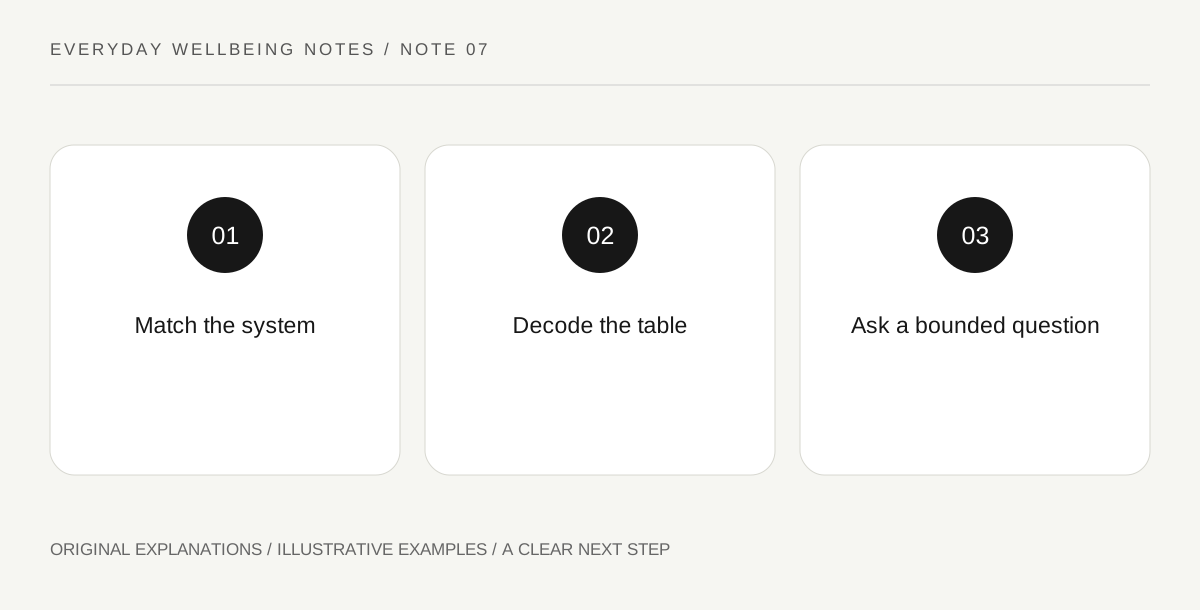
Original explanatory diagram. Read the full method and limitations below.
Match the report to your water system
EPA describes Consumer Confidence Reports as annual drinking-water quality reports for community water systems. Locate your actual supplier and the report’s year. A county name alone may cover several systems. Keep the system identity with any excerpt you save. If you do not know the supplier, ask the property manager or relevant local service instead of selecting the first report whose place name looks familiar.
Read the table headings and units
Identify the named substance, measurement unit, reporting statistic and comparison value before judging whether a number is large. A range, average and maximum describe different summaries. Do not compare them as if each were the same kind of result. Use the report’s explanatory key and ask the supplier about unclear terminology. A decimal with many places is not automatically a sign of either danger or exceptional purity.
Keep the reporting period attached
Find when the data were collected and what period the report covers. A report published this year may summarize earlier monitoring. If a current notice exists, follow its instructions rather than treating the annual document as a more authoritative all-clear because it looks formal. Conversely, a past issue described in a report should not be presented as a newly discovered emergency without checking its context and subsequent official information.
Turn a household concern into a specific question
If your concern involves a particular tap, building plumbing or a change noticed today, explain that to the supplier or appropriate local authority. Ask what the system report can and cannot establish for that question. Do not interpret a system-wide summary as an individualized test of every fixture. Save any recommended next step with the concern, rather than drawing a treatment or health conclusion from an unrelated table row.
Illustrative worked example
Illustrative example: Tori receives a report and sees a highlighted number in a table. Reading the heading reveals that it is a range for a stated monitoring period, not a live reading at Tori’s kitchen tap. Tori keeps the units and system identity in a question to the supplier about a separate current concern. The fictional example does not interpret a real contaminant level or certify a water supply.
Questions that come up
Does the publication year mean every sample was collected this year?
Not necessarily. Read the monitoring dates and reporting explanation. Publication timing and sample timing are separate pieces of information that should remain attached when you share a result.
Can the report settle every question about my tap?
No. Ask what its system-level information establishes and whether a household-specific concern needs another assessment. Do not treat a general report as a test of each fixture or as permission to ignore a current local notice.
References and scope
These sources support the factual background. Examples and exercises are original illustrative teaching material. References do not imply endorsement.
- EPA: annual water-quality report — Community water-system Consumer Confidence Reports describe annual water-quality information, not a live household notice.
- CDC: drinking-water advisories — Boil-water, do-not-drink and do-not-use notices are different; follow the current local notice.